More Reasons You Need an Author Website
A guest post for Two Birds Author Services
“I only have one or two books out, it’s probably not worth doing a website yet.”
“I’m not published. I’m not a real writer.”
“My publisher hosts my books, I don’t need my own website.”
“I don’t have any books to promote.”
“I use Substack/Bookshop/an Amazon storefront/etc. so there’s really no reason for me to go to the time and expense of setting up my own.”
“I haven’t told anyone I write. It feels too private, I don’t want to tell anyone in case I fail.”
If any of these thoughts sound familiar, grab yourself a cup of tea or coffee and let’s chat. And if you’re struggling with imposter syndrome—I have and still do—please hear me: if you’re writing, you’re a writer. Whether you’re protecting a dream you’re scared to share or you’ve been letting something else carry this for you, the answer is the same—having an author website isn’t a nice-to-have anymore, even though the ways we can get ourselves out there without one are always expanding and evolving. But there’s one thing an author website gives you that absolutely no other platform does:
Ownership.
Engagement on social media platforms is constantly shifting, and we don’t have any power over how the algorithms work. If you self-publish, you need to have a space outside of Amazon or Bookshop where you can decide what is presented about you. If you’re traditionally or hybrid published, you need a space to showcase your books that is publisher-agnostic. Your website gives you control over not just of what you write, but how you present yourself to the world. Yes, Substack has a lot of potential, but you’re still very limited in how your content is structured, and they’re all homogenized. Having your own web space is important for several reasons:
Home Base
Remember being a kid and playing tag, or other playground games, and what a relief it was to have a central base, an anchor point you could return to when you needed a reset? Or how as an adult, people you care about know how to find you, and at the same time you have a home where you can sink into the couch by yourself when the world is A Lot? That’s what your website is, but that’s also what it is for other people in relation to you. If someone learns about you or your work, it’s a place they can go where all your information is centralized. Books? Yep. Bio? You got it. Links to all the other places you are? Absolutely. Your website is where you can present a comprehensive view of your brand—more on that in a bit—instead of a fragmented one.
And for you personally, your website is also the place you can return to when you need to feel grounded, when all the voices coming at you from all the directions get too loud. The thing that reminds you what you’re doing and why.
My pre-writing career was in non-profit management, so I spent over a decade thinking about mission statements, writing mission statements, and contextualizing mission statements. And yet it wasn’t until recently that I really considered mission statements for my life and my writing career. But your mission is crucial, and it’s so helpful to have it articulated. It’s a clear values statement, goal statement, and bumper guards, all wrapped into one. It should be the central feature of your website because it’s the thing that tells everyone—yourself included—who you are as a writer (and what you write!) and why.
I’m not saying your mission should eclipse your books or even be explicit. But what I am saying is that your mission should be part of the very fabric of your website, from your color choices to your content choices to your image choices. Every choice you make with your brand—which is primarily personified in your website—should be made with your mission in mind. That way you’ll always have a touchstone for yourself when you need a reminder, but it’s also clear to everyone who visits your website exactly who you are.
TLDR: your website is where you and your story are fully encapsulated for yourself and others. Take the time to build it carefully and thoughtfully (get someone to help you, if you need to!) so that it becomes the hub for all the pieces you share with the world.
Direct Links to Readers (and other people who influence your career)
Instagram doesn’t provide you a direct link to readers. Neither does Facebook. Or Threads. Or BlueSky. Or any of the others. Your attempts to communicate with your followers are always filtered through an algorithm that we as authors do not have any power to influence, or often even understand. Your website is the only place where you know with absolute certainty that a person visiting it will see your content. And with that, I recommend giving people who are interested in you and what you have to offer a way to hear from you directly by collecting email addresses on your website. This way when you have news to share you can communicate with them directly, not hope the social media algorithm gremlins will smile favorably upon your post(s), giving you a direct link to your readers and a way to level people up: casual visitor → reader → loyal fan.
TLDR: collect email addresses via your website so you can communicate directly with people who want to hear from you.
Image and Brand
Your website is a public, visual representation of your identity as a writer. It’s the public landing space for your brand, and whether you’re thoughtfully curating your brand or not, you absolutely have one.
“Brands” are often thought of from a corporate and product perspective, but if you’re trying to share your work with the world, that work—and you as an author—are a product. Every piece of your website, from the colors to the font to the content to the use of images, melds into an amorphous vibe that tells the person interacting it a bit about you.
Take, for example, the websites of Ruth Ware and Emily Henry:
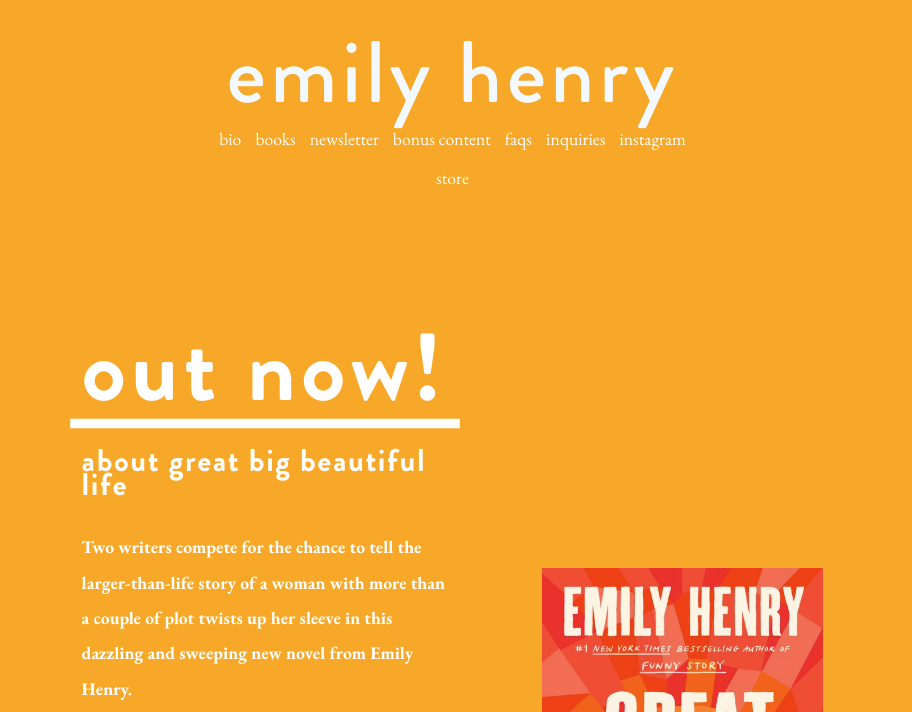
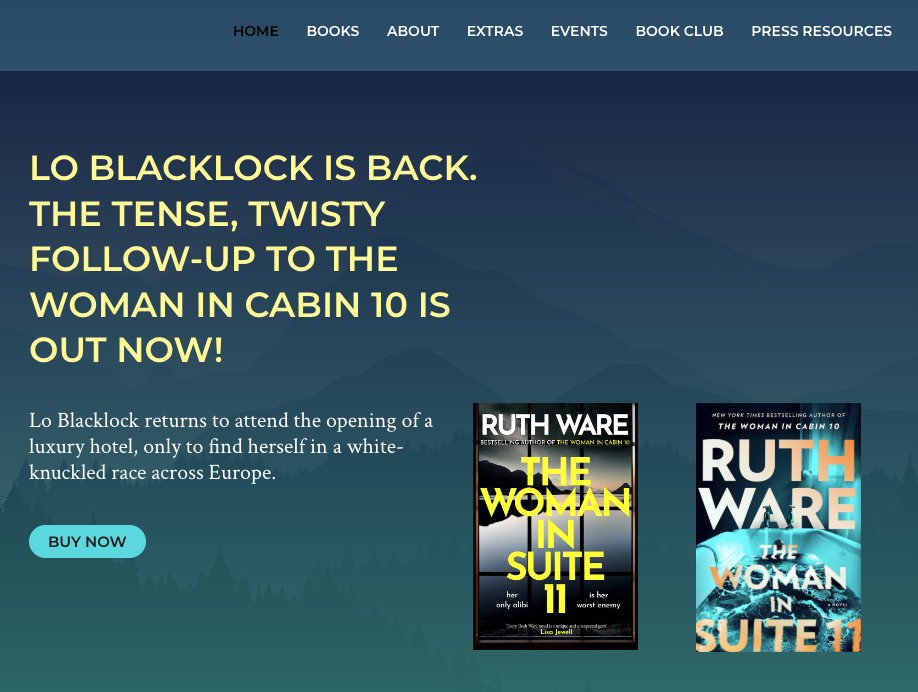
Without reading a single word, you can get a feel for what the vibe is of each author and their work. Thoughtful, moody, intense…whimsical, fun, playful. The composition of all the elements of your website let you shape how you present yourself, not just your work, a limitation that publisher sites and Amazon and yes, even Substack, can’t compete with.
Who are you? What kind of work do you do? What themes do you tackle? What should people expect from an interaction with you, or from reading your work? That kind of personalization isn’t something that a tool intended to homogenize us all into one “author” bucket can touch.
TLDR: Your website lets your personality and the personality of your work shine. You have a brand whether you actively cultivate it or not, and your website sets the tone.
Professionalism
Whether you have an area of focus beyond writing or not, at some point you’ll need to sell yourself to someone. Agents, publishers, journalists who may want to interview you, event organizers who may want to invite you to speak, publicists and scouts who may consider you for a podcast or other engagement…all these people will expect that you have your own website. I can’t honestly tell you it’s a dealbreaker not to have one, but I can tell you that having your own branded website and domain signals that you take your work seriously and you want to make yourself and your work easily accessible to the world.
TLDR: Having your own website—not being published—is one of the few things that separates the professionals from the amateurs, which has nothing to do with having a book out in the world and everything to do with mindset.
Ability to Evolve
Because of your complete control (there’s that word again!) you have the ability to adapt your website and let it grow with you. If you’re not yet published, you can leverage your website—as I do—to publish an agent guide, featuring content you simply can’t include in a query. Because it’s not directly and overtly selling a product—or not only doing that—you can increase buy-in to you as an author, which guides people naturally toward your books or other work. And as your career grows, your site can become an archive of deal announcements and launch information and media appearances. If you’re in a period of book marketing, you can leverage it for special or bonus content, post videos or links to curated playlists, or whatever else you can think of to market the book. If you’re not actively marketing, you can shift focus to your backlist in addition to a new release. Having your own website is like having your own home: you can move furniture or buy new when and however you want, a benefit that lets you be nimbler and more responsive with your brand than you can be if you’re relying on pre-baked platforms.
TLDR: Your website is how you grow the foundation that supports your work, and it becomes the embodiment of your legacy.
About Sarah Berke
I write emotionally resonant upmarket fiction about family, friendship, and the tragedies and joys of life. I also publish the essay series Eliciting Esperance: Notes on Living bimonthly on my website and on Substack.
I believe nothing should stand in the way of you and your dream, but that your time is best spent writing. I help make the most of your capacity by helping articulate your brand and develop a website for you, transforming it into a public, visual representation of your identity as a writer, leaving you free to do more of what you love.
As a former managing director for professional associations, I perfected the art of juggling deadlines and working on teams—skills I now use while negotiating with my spirited elementary school daughters and a badly behaved beagle, crafting complex characters, helping authors build the website of their dreams, and volunteering for my daughters’ school and the Women’s Fiction Writers Association.