The Book Ban Is Not The Point.
And we cannot have meaningful conversations about difficult issues when people in power deliberately construct an emotional narrative that prevents us from asking the actual questions.
We cannot have meaningful conversations about difficult issues when people in power deliberately construct an emotional narrative that prevents us from asking the actual questions.
Warning: I swear in this audio, and there are mature topics discussed. I would advise not listening to it with kids around.
Three weeks ago, on September 17 at 8:42 pm, I got a message through my kids’ school district’s communication portal and via email. In a nutshell, this notice said “congratulations to us. We found an objectionable book and pulled it off the shelves of our schools.” And then included the violent, graphic, sexually explicit passage.
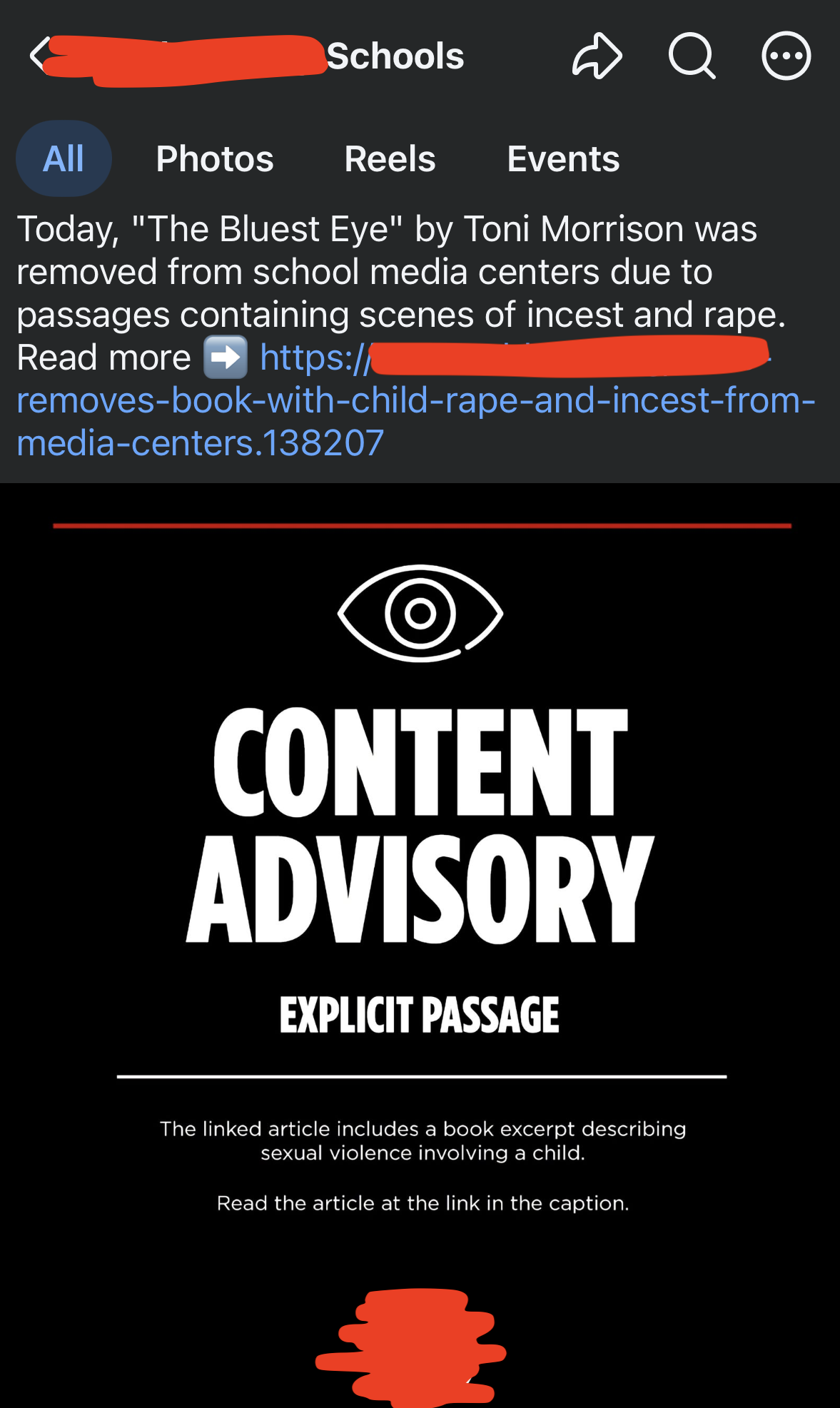
So basically, I got an email ostensibly about protecting children from this graphic depiction of child rape and incest—and that same depiction, I soon learned, was read aloud at a public school board meeting, publicly accessible on the school district’s website in the transcript of the remarks, and linked from the school district’s official (public) Facebook page, all of these, of course, are accessible to students. The e-mail and the transcript of the superintendent’s remarks are reproduced in the comments of my initial rant about it, available here, here, and here.
I had a lot of reactions to this, but the foremost was: what the actual fuck is he doing?
(“He” being the superintendent.)
There are about forty-seven things wrong with both the email and how it was handled by the school district that speak to a much larger societal problem (and no, actually, I’m not talking about book banning, though I’ll get there), but the key point is that there is a remarkable amount we were told about the contents of the book, and an equally remarkable amount we were not told about its actual availability to children.
Here’s what we know, either from the email or from the superintendent himself:
Six weeks before the notice went out and was simultaneously announced at the school board meeting, the superintendent said in his school-year opening remarks to teachers that people who don’t want to ban books support child trafficking. Here’s the exact excerpt:
“Every two minutes, a child is sold into trafficking in the United States of America. Let that sink in. Every two minutes. Now, folks, the sexually inappropriate materials we removed from this school district have one intended action. To condition kids at a young age to accept this whole deal around trafficking is normal in some way, shape, or form. And either you agree with protecting kids or you don't. There's no politics involved…What's even more disturbing is that the environment that I just described, there are some of those very people who think that we are doing the wrong thing by removing these inappropriate sexually explicit materials who have chosen to run for the board of education. Make no mistake about it. It's about the protection and safety of kids. Nothing having to do with politics." (Note: this is a non-continuous excerpt, and I’ve included the full transcript–unedited except to remove timestamps for readability and redact the district and superintendent’s names—here. The video is publicly available on YouTube and I used transcription software for the text version.)
In the state of Georgia, it is the law that kids receive human trafficking awareness education annually beginning in 6th grade (O.C.G.A. § 20-2-142 — amended by HB 287 (enacted 2021), and implemented through GA DOE Rule 160-4-2-12, if you’re interested).
The superintendent learned of the book from other superintendents (not a district parent or “qualified media personnel”, per the district’s policy).
He then learned that the publisher sold one or more copies to district media centers.
He then decided the book violated the school district’s sixth through twelfth grade curriculum standards, a decision the district’s own policy says should be made by “qualified personnel:”
“[DISTRICT]’s library media rule provides for qualified personnel to evaluate materials and recognizes parents' right to raise concerns through established procedures. It also requires library materials to support the curriculum and District goals and subjects their selection to Georgia law, including requirements concerning material harmful to minors.”
September 17, the notice announcing its removal was distributed either during or immediately following a school board meeting and included the sexually graphic depiction of rape and incest.
At roughly the same time, the passage from the book was read aloud in the meeting by the superintendent.
But the following information wasn’t offered, so we don’t know:
When the book was purchased;
Whether it was still in circulation;
Whether it was still currently available to students on any media center shelves;
Whether it had ever been checked out;
Which grade levels had access to it.
Crucially: a book having been purchased at some point by the school district is not the same thing as an eleven-year-old being handed that book.
Before I go any further, I also want to explicitly say something about the people who do this work every day—the librarians, media specialists, teachers, administrators, and everyone else in the middle of this cultural political war—thank you. I’ve truly never met someone in one of these positions who wasn’t an absolute gem of a human being, who didn’t have the best interest at heart of the kids they serve.
Books are evaluated—according to the superintendent’s own remarks and the district website–against curriculum standards for sixth through twelfth graders. And I’m here to tell you, there’s a helluva big difference in maturity between an eleven-year-old and an eighteen-year-old. Would my sixth grader, if I had one, be ready to read The Bluest Eye, the book at the center of this? Probably not. Would my 12th grader? Yes. Because the question isn’t whether a book is inappropriate for children, it’s whether that book is inappropriate for particular children at a particular developmental stage. And those are not the same question. But that question is getting lost in the noise.
Because here’s the thing: there was absolutely no reason to make a public announcement about this book’s removal, especially considering prior removals have not been similarly announced. But there’s a fiercely competitive school board race which, if the seat flips, puts the superintendent’s job in jeopardy for the first time in a long time. He specifically referenced this candidate in both his school-year opening remarks and the remarks at the September 17 school board meeting.
Which happened to be two and a half weeks before the voter registration deadline in Georgia, and a month before early voting starts.
And if that school board seat flips, then his contract would be in jeopardy for the first time in a long time. A contract worth over a half million a year (base salary over $400k) with a buyout of over a million dollars.
Friends, the reality is that every single person has specific motivations for every action they take, whether they’re aware of it or not. I certainly have a motivation in laying this out and making it publicly available. And right now, with less than a month to the election, my biggest concern isn’t actually the banning of books. It’s that the banning of books and the well-being of my children was weaponized for political gain and to serve personal ambition. We are being used against each other as pawns in a game we haven’t asked to play, and which many people don’t realize they’re playing at all.
This is an election year, and we’re being used. Our kids are being used. It’s our civic duty to vote, but it’s also our civic duty to question our leaders. And to do that, we have to start with critical thinking.
We have to stop falling for the political and ideological theater and take responsibility for having conversations where we listen more than we talk, and conflicts where we try to find common ground instead of further divide.
I would love to have a calm, rational, intelligent conversation about the banning of books, an issue which, I think, is much larger than books. It’s really about parental authority vs. social responsibility. There is strong precedent for governments taking an active role in protecting the well-being of children, and there is strong evidence that book bans originate not with parents, media specialists, or teachers, but with specific political groups or government officials (92% last year).
What this all comes back to is people in power saying things that they hope we won’t look too hard at or think too much about. This entire situation was orchestrated for maximum emotional response, and we have to think critically. We have to stop—on both sides of the aisle, both sides of the book ban issue, both sides of any issue—taking information from a source and assuming it’s valid. We need to consider where it comes from. We need to consider the contextual information that comes with it (or doesn’t, in this case).
The superintendent—as with all of our elected or appointed officials, or anyone in a servant leadership position—is tasked with the unbearably difficult job of making decisions about education (and access to books…) for lots and lots of families—in this case, over 100,000 students. But if you strip back the bullshit in the email and his remarks and get to the heart of the issue, what we need is to have a conversation about what books and what content is appropriate at what age, who gets to make that decision, and what happens when parents are in conflict about our beliefs and how our kids should have access. That's an argument that we need to be having, instead of fighting about the inflammatory nature with which this particular book ban was handled.
Except…I think the inflammatory response was the point. And we have to find a way as parents and human beings to see through it and have an actual conversation about the issues. Because you know what? I know a lot of people who believe the same way I do who make very good points. And I also have friends who don’t feel the same way I do, and they also make reasonable points. And the only way we’re going to get anywhere meaningful is if we stay calm and respectful, recognize how deeply personal these issues are on both sides, and remember that we’re all fighting for the same thing: what’s best for our kids, for us, and our communities.
A word about book bans, specifically:
I actually think there’s a legitimate conversation hiding underneath all of the posturing.
I agree with the superintendent—I wouldn’t want my eleven-year-old, when my daughters get to that age, coming across a graphic passage about rape and incest. My eighteen-year-old, though, lives in a world steeped in sex and violence already. A twelfth grader can handle content that a sixth grader isn’t ready for, and no one is arguing that they should have to.
Not every book is age-appropriate at every level. And not every book belongs in every school library. I don’t think parents should have no say in what their children encounter, and I don’t think protecting children from material that could be traumatic is political censorship. These are all reasonable things to discuss.
What I object to is pretending that these are the questions we’re being asked when the information we’re given—and the decisions made for us—are carefully constructed to make us angry before we have a chance to ask them.
I’m against book bans. But I am very much in favor of my kids not being exposed to things that are outside their maturity level, and those are two different things. And the difference comes down to whether the “inappropriate” material is age-appropriate curation or ideologically motivated removal. And the problem is when bad actors try to use this very valid child development consideration to restrict access to books with which they don’t ideologically agree (“Of the unique titles challenged in 2025, 1,671 (39%) represent the lived experiences of LGBTQIA+ people and people of color.” – ALA). That’s when we move from a child-centered view to a parent-centered view. We have to be careful about not stepping over that line, from protecting our own children from something we don’t want them exposed to to protecting all children from something we don’t believe they should encounter.
Because what’s best for kids, and for our society at large, is when they’re exposed to people who are different from them. Because that’s where tolerance, empathy, critical thinking, and compassion grow. Not from homogeny, but from diversity. And the line we have to navigate is that parents have authority and responsibility over their own children, but a public school serves children with different families, experiences, identities, and developmental needs.
I haven’t ever heard anyone argue that kids should have unfettered access to any content, but we also need to consider whether that standard of protecting children from inappropriate content is being applied consistently. I am not, for instance, seeing similar fights about violent, graphic, sexually explicit commercials that often air during sporting events televised during the day and which my children are exposed to without my consent while their dad/my husband watches football or baseball. All ages of humans should filter the content they’re exposed to based on age-appropriateness, temperament, potential for trauma, and personal triggers—and yes, for kids, this means that an adult with a fully formed brain has to make the judgment about whether content is appropriate for that child.
But kids do need to be exposed to things and people which are different from the way they live their daily lives. And, whether certain factions of people want to face it, there are kids who grow up with two parents of the same sex, or are themselves non-binary or gay, or are a person of color, or practice a different religion, or live in poverty, or any number of things that make us different. Because this isn’t about libraries or books or the superintendent or any of the other noise surrounding this issue—it’s about what reading does. It’s about how kids develop when they’re exposed to differences in life and identity and ideology.
The reality is that my kids are exposed to content all the time that I don’t agree with, or which they’re not developmentally ready for, including in school. That’s how life works, and that’s how kids grow and learn. I don’t love my kids reading Barbie or princess books because the characters are predominately thin and white, and often saved by a man, but I let them explore books based on their interests and, if there’s something I don’t agree with, then I talk to them about why. Because it’s my responsibility as a parent to discuss our family’s values and beliefs with them instead of blindly indoctrinating them with what I believe. I want my kids to question me. I want to have to defend my beliefs. Because I want them to develop empathy, and to understand that their experience isn’t the universal human experience.
Because protecting children doesn’t mean protecting them from difference.
And this, my friends, is where it all ties together. This is the part that worries me more than banning any individual book. It’s that we’re becoming extraordinarily easy to manipulate. We’re given an attention-grabbing headline and a graphic quotation, then we’re told that someone is coming for our children and trying to indoctrinate them. We’re given enough information that it’s easy to overlook what information we’re not given.
And then we’re told that someone is lying to us.
I urge you, over this next month, to look at what we’re told. Look at what we’re not told. And ask yourself why.
A personal note: As a person who broadcasts a lot of myself online, I try to be as transparent and authentic as I can. My children, however, are not of age to make such a choice. So out of respect for their privacy (and potentially safety, because the internet is a wild place) I am intentionally not specifying the name of the county/school district in which I live. If you know me personally, please don’t put any geographically identifiable information in the comments that is more specific than the state of Georgia.